The Hidden Cost of Employee-Managed Email Signatures, With Real Numbers
The cost is not the signature. It is the process behind it.
Most companies do not budget for email signature management. It is seen as a small admin task. Someone creates a template, sends it to employees and asks them to copy it into Outlook or Gmail. On paper, this looks free.
In practice, employee-managed email signatures create hidden costs across IT, marketing, HR, legal and sales. The cost appears in repeated support requests, inconsistent branding, outdated campaigns, compliance gaps and lost attention from prospects.
The real question is not, “How much does an email signature cost?” It is, “How much does the company lose by letting every employee manage it manually?”
Where manual signature costs come from
Employee-managed signatures create cost in five main areas:
- IT time spent helping users install or fix signatures.
- Marketing time spent creating instructions, checking layouts and chasing adoption.
- HR or operations time spent updating starters, leavers and role changes.
- Compliance time spent checking whether required company details are present.
- Revenue leakage from missed campaign clicks, inconsistent calls to action and poor brand presentation.
The problem gets worse as headcount increases. A 20-person company can often manage signatures informally. A 200-person company cannot do that without waste. A 1,000-person company will usually find that manual control has become impossible.
A simple cost model
Let’s use a realistic mid-market example. Assume a company has:
- 250 employees
- 25 new starters per year
- 20 leavers per year
- 35 role or department changes per year
- 4 company-wide campaign banner updates per year
- 2 brand, disclaimer or template changes per year
Now apply conservative time estimates:
- 10 minutes for each employee to update or check their own signature
- 15 minutes of IT or operations support for 25% of employees who have issues
- 4 hours of marketing time per campaign update for template creation, checking and internal communication
- 3 hours of compliance or management review per legal or company information update
Cost of employee time
For each company-wide update, 250 employees spend 10 minutes each. That equals 2,500 minutes, or 41.7 hours.
If the company runs 6 updates per year, 4 campaign changes and 2 template or disclaimer changes, employee time equals:
41.7 hours x 6 = 250.2 hours per year.
If the average loaded employee cost is £35 per hour, that is:
250.2 x £35 = £8,757 per year.
This is only the time employees spend copying, pasting and checking signatures. It does not include IT, marketing or compliance.
Cost of IT support
Assume 25% of employees need help after each update. That is 62.5 support cases per update. At 15 minutes each, that equals 15.6 hours per update.
For 6 updates per year:
15.6 x 6 = 93.6 IT hours.
At a loaded IT cost of £50 per hour:
93.6 x £50 = £4,680 per year.
Cost of marketing coordination
Marketing creates the banner, writes the internal instruction, checks test emails, chases adoption and answers questions. If each campaign update takes 4 hours and there are 4 campaigns per year:
4 x 4 = 16 marketing hours.
At £45 per hour:
16 x £45 = £720 per year.
This looks small, but the bigger cost is campaign underperformance. If only 70% of employees add the banner correctly, 30% of the company’s email traffic carries no campaign message at all.
Cost of HR and operations changes
New starters, leavers and role changes are constant. If the business has 80 people changes per year and each one takes 10 minutes for the employee plus 10 minutes for support or checking, that is 26.7 hours.
At a blended cost of £40 per hour:
26.7 x £40 = £1,068 per year.
Again, this excludes the risk of old titles, former employees, wrong phone numbers and incorrect team information staying live.
The visible annual cost
Using the assumptions above, the measurable annual cost is:
- Employee update time: £8,757
- IT support: £4,680
- Marketing coordination: £720
- HR and operations updates: £1,068
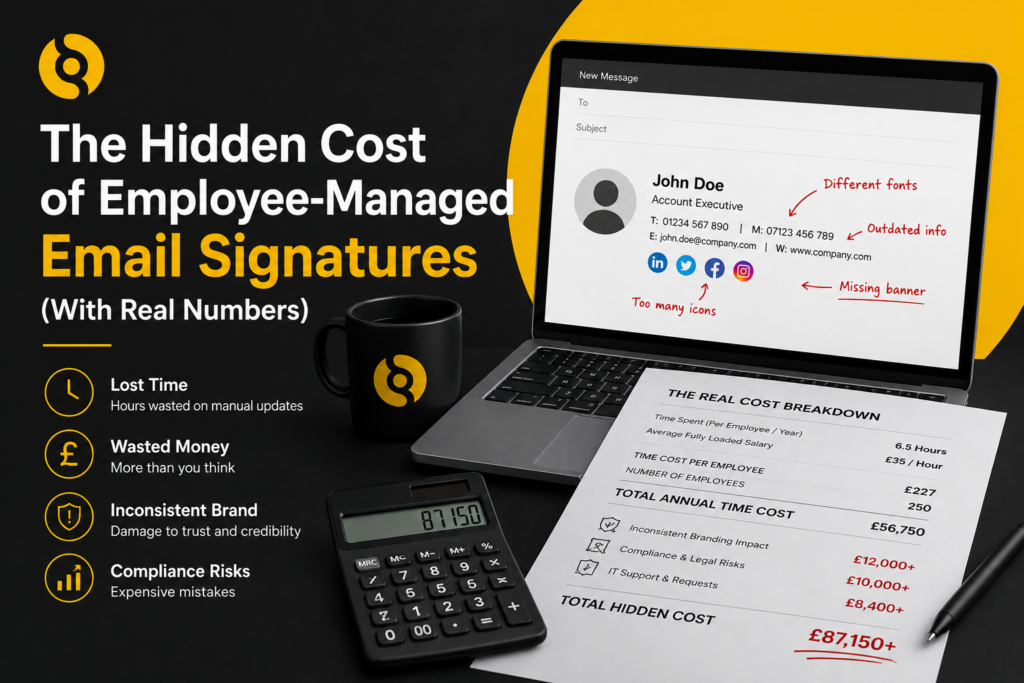
Total visible cost: £15,225 per year
This is a conservative model for a 250-person company. If your headcount is higher, if updates are frequent or if your IT team spends more time fixing formatting issues, the cost rises quickly.
The hidden cost is often larger
The visible cost is only part of the problem. Employee-managed signatures also create brand and commercial risk.
A sales team using inconsistent signatures may send prospects to different landing pages. A recruitment team may keep promoting an expired hiring campaign. A regional office may use the wrong legal entity details. A mobile user may send emails with no signature at all. A new senior hire may appear with an incomplete job title in early customer conversations.
These are hard to price, but they matter. B2B buyers judge suppliers through small signals. If a company cannot keep something as visible as email signatures under control, it can affect trust.
Why instructions do not solve the problem
Many companies try to fix manual signatures with better instructions. They create step-by-step guides for Outlook, Gmail, Apple Mail and mobile devices. They record internal videos. They send reminders.
This reduces confusion, but it does not remove the core problem. Employees still need to take action. Every device still behaves differently. Every campaign still depends on adoption. Every update still needs checking.
The better approach is to remove manual work from the process.
How centralised email signature management changes the cost model
With email signature management software, templates are created centrally and applied automatically. Employee details are pulled from a directory. Campaign banners can be scheduled. Different departments can receive different versions. IT does not need to ask employees to copy and paste anything.
SIGNandGO supports centralised email signature management for Microsoft 365, Exchange and Google Workspace. It is designed for companies that want consistent signatures without relying on user-side setup.
This changes the cost model in three ways:
- Updates happen once, not hundreds of times.
- Users do not need to install, edit or repair their own signatures.
- Marketing and compliance teams can control approved content without turning every change into an IT task.
The real cost is control
Employee-managed signatures look free because the cost is spread across the business. It sits inside small interruptions, support tickets, campaign gaps and inconsistent branding. Once the numbers are written down, the cost is easier to see.
For a 250-person company, manual signature management can easily consume more than £15,000 per year in visible time cost alone. That does not include missed clicks, legal risk or the brand damage caused by inconsistent communication.
The practical answer is central control. A company-wide email signature should not depend on every employee following instructions correctly. It should be managed once, applied automatically and kept accurate across every email client and device.